Information
|
Item |
Detail |
|
Name |
Circuit design for Vehicle Chargers,Design of Automotive lighting circuits,Circuit design for automotive ambient lighting |
|
Customization and service |
Production and development: Supports appearance customization (color/Logo/material) and function customization (hardware configuration/software functions), provides DFMEA analysis/DFM reports, and the development cycle is 20-30 working days |
|
Production and quality control |
Production process: SMT assembly, complete machine assembly, injection molding processing, CNC processing Quality system: Passed ISO 9001 and implemented full-process inspection of IQC/IPQC/FQC |
|
Cost and Business |
Quotation mode: Provide a stepped quotation (the larger the quantity, the lower the unit price) Cooperation mode: Supports OEM/ODM cooperation, providing cooperation methods such as joint research and development and technology licensing |
In the automotive industry, the circuit design of automotive electronics is of utmost significance. It serves as the "nervous system" of vehicles, integrating and controlling a wide range of electronic components to ensure the proper functioning of various automotive systems, from safety to in vehicle infotainment systems.
Design Challenges
Automotive electronics circuit design faces numerous challenges. The operating environment of vehicles is harsh, with extreme temperatures ranging from - 40°C to 125°C, high levels of vibration, and exposure to moisture, dust, and chemicals. Therefore, components used in automotive circuit design must meet strict standards.
Electromagnetic interference (EMI) and electromagnetic compatibility (EMC) are also critical concerns. Vehicle electronics systems generate and are exposed to a variety of electromagnetic fields. Circuit design must be optimized to minimize EMI emissions and ensure that components can operate properly in the presence of external electromagnetic interference.
Design Process
Requirement Analysis
- First, designers need to understand the specific requirements of different automotive systems.
- In in - vehicle communication systems, such as Controller Area Network (CAN) and Local Interconnect Network (LIN), the circuit design should ensure stable data transmission with low latency. CAN is often used for high - speed, real - time, and safety - related control signal transmission, while LIN is suitable for low - speed communication networks.
Component Selection
- Microcontrollers (MCUs) are at the heart of many automotive electronics circuits. For example, the ARM Cortex series is widely used in automotive applications. These MCUs need to meet automotive - grade requirements, with features like low power consumption and high - level anti - interference capabilities. In the case of an ECU, the MCU manages complex tasks.
- Sensors and actuators are also key components. Temperature sensors, pressure sensors, and acceleration sensors must provide highly accurate measurements and be able to withstand harsh environmental conditions. Actuators, such as motor drivers and valve controllers, need to work in conjunction with power electronics technology.
Circuit Schematic Design
- Designers create circuit schematics that define the electrical connections between components.
- In addition to basic power conversion, protection circuits are also designed to prevent issues like voltage inversion, over - current, and over - voltage. For example, a diode may be added to prevent voltage backflow, and a fuse or current - limiting resistor can protect against over - current situations.
PCB Layout Design
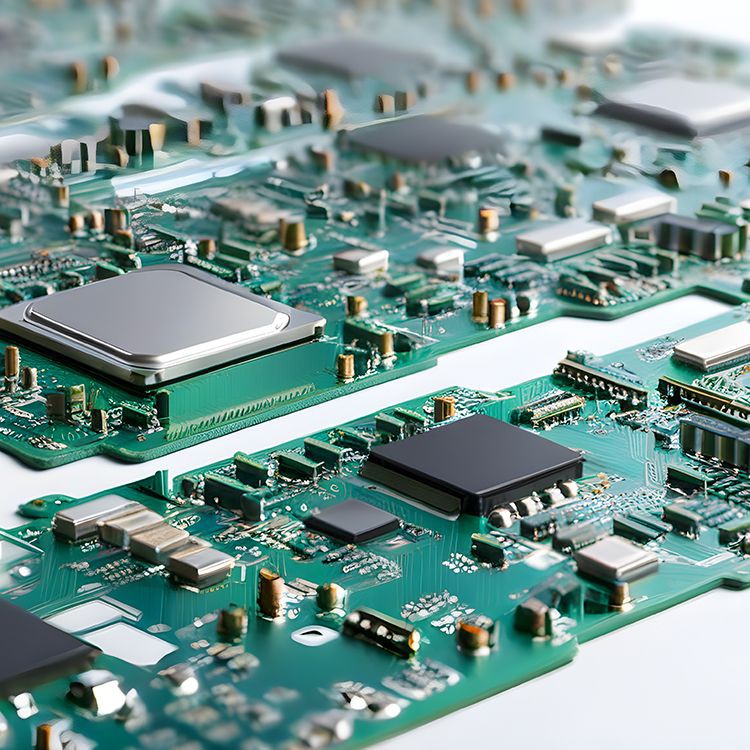
- The printed circuit board (PCB) layout is designed to optimize the physical arrangement of components and electrical connections. To reduce electromagnetic interference, proper grounding and shielding techniques are applied. High - speed signal lines are carefully routed to minimize signal reflection and crosstalk.
- Thermal management is also an important consideration in PCB layout. Power - consuming components, such as power transistors and integrated circuits, are placed in areas with good heat dissipation, and heat - sinking structures or thermal vias may be added to ensure the components operate within a safe temperature range.
In conclusion, automotive electronics circuit design is a complex and challenging field that requires a deep understanding of automotive applications, electronics technology, and strict industry standards. It is constantly evolving with the development of automotive technology, aiming to provide safer, more efficient, and intelligent driving experiences.
FAQ
Q: What manufacturing services does DASHCONN provide?
A: DASHCONN is a one-stop shop to meet all your manufacturing needs. We provide full English customer service, whether it is product communication, negotiation, logistics and after-sales service, so that your products can move forward from concept to market.
Our services include everything from rapid prototyping to small or large batch production. Warmly welcome you to visit our design lab and factory at any time, and with DASHCONN, you have a trusted partner.
Q: What payment terms does DASHCONN support?
A: We accept bank transfers.
Q: Which are the available shipment types and transit times?
A: At DASHCONN, we understand that shipping plays a critical role in the success of your project. That's why we offer our customers two different modes of transport are available for selection: DHL, or using your own account to select a courier company or transport agent.
Q: How does DASHCONN protect my intellectual property?
A: In DASHCONN, we know how critical information security is, especially when working with high-value design IP. That's why we designed our platform with elite-level security and confidentiality as a top priority. From log in to file upload to part fulfillment.
In addition, we can sign an NDA agreement with you to ensure that your original design drawings will not be leaked.
Hot Tags: circuit design for automotive electronic products, China circuit design for automotive electronic products manufacturers, suppliers, factory, automobile parts solution, instruments and equipment solutions, design of automotive electronic products, Consumer electronics solution, Software And Hardware Of Household Appliances, Automotive Parts Software And Hardware